The starting point
Collecting decisions was the first step.
The initial task was practical: retrieve relevant Taiwanese court decisions and keep the full text available for research. The project focused on judgments concerning controlled substances and pharmaceutical law.
A collection of documents did not yet provide a reliable comparison. A relevant term could appear in a background reference, a procedural discussion or the main issue. Those uses needed to be distinguished before a document could enter an analysis group.
Early collection also exposed limits in the source search interface. Search results could be capped. A set of retrieved decisions therefore needed a clear coverage definition before it could support a claim about the wider population.
Structured records
Separate what the text says from how it is measured.
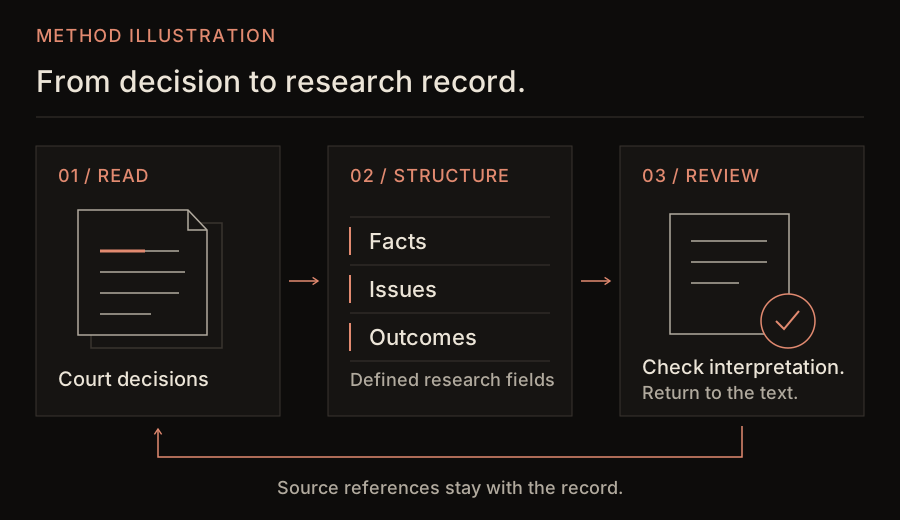
The next stage turned decisions into research records. Explicit rules handled stable patterns and document structure. Semantic extraction helped organize facts expressed in varied language. Both routes had to preserve a link to the original material.
Field definitions became a central part of the work. A sentence attached to one count and a combined sentence across several counts describe different things. A mention of a substance and a finding about that substance also carry different meanings. Combining them under one label could produce a plausible-looking result with the wrong interpretation.
Cross-checking helped expose these differences. Agreement between two extraction routes was useful evidence, but it did not replace reading the source. A disagreement could reflect a definition mismatch rather than a failure to identify the text.
June 2026 / analysis framework
Comparable decisions require comparable conditions.
By June 2026, the project had documented a repeatable framework for judgment analysis. A central rule was to compare decisions within defined legal and factual groups.
Differences in the cases entering each group could otherwise become differences attributed to a court, a participant or a research factor. The analysis therefore needed explicit group definitions, consistent eligibility rules and checks for unusual results.
A comparison begins with the definition of the cases being compared.
The result was a workflow supported by method notes, comparison reports and a validation checklist. These artifacts made the research easier to repeat after the underlying records changed.
July 2026 / a clearer research corpus
Source coverage became part of the method.
The collection strategy developed around bulk open-data releases as the main source, with incremental collection supporting newer material. This reduced dependence on search result lists and made the boundaries of the research corpus easier to describe.
The project also consolidated its research data and analysis pathways. On 12 July 2026, it adopted the name MKULTRA. The work continued to center on how public judicial documents could support repeatable research.
A larger corpus still needed consistent inclusion criteria. Changes in what entered the corpus could affect comparisons across periods. Coverage and membership rules therefore had to be examined alongside the results.
Publishing the research
The report needed a repeatable path back to the data.
In June 2026, the report website moved to a static publication workflow. Research computation and the delivery of generated pages became separate steps. The published material could then be rebuilt from the analysis outputs.
The presentation also evolved. During August 2026, the project formalized its writing rules: short sentences, stable terminology, clear population definitions and visible uncertainty. A chart needed to explain its measurement scope. A description needed to distinguish an observed pattern from a causal claim.
These choices were part of the research process. They gave readers enough context to examine a finding and understand where its interpretation stopped.
October 2026 / review and revision
Keep the correction process visible.
Later work placed more emphasis on provenance, measurement definitions and the identity of the items described in a decision. A value could be extracted correctly and still belong to the wrong item. A source label could remain unchanged while the analysis behind it evolved.
October reviews examined those boundaries and revisited earlier assumptions. Some work reached offline validation; other repairs and report updates remained open. The project records distinguish those states so that a successful local check is not presented as a completed production update.
MKULTRA has produced a collection and tagging workflow, structured research records, analysis methods and generated reports. Its continuing task is to keep the source, field definition, comparison rule and published explanation aligned as the work develops.
Selected research observations
What the historical searches show.
A retained collection snapshot from June 2026 provides a broad view of substance-related criminal-document searches over the complete years 2022–2025. The public results use annual indices, with each keyword’s 2022 total set to 100.
- Ketamine-related search totals increased.The index reached 224.0 in 2025 against a 2022 baseline of 100.
- Cannabis-related totals also rose.The 2025 index was 142.6. This describes matching documents in the retained searches.
- Other trajectories differed.Methamphetamine ended 2025 near its 2022 level after higher intermediate years. Heroin declined from its 2024 level while remaining above its 2022 baseline.
These observations concern document-search matches. They do not measure unique cases, people, drug use or market share. Related proceedings can generate several documents, and one document can mention more than one substance.
The public view groups the data at the national annual level. It contains no names, case references, court breakdowns or individual source text.
Explore the historical research viewDevelopment timeline
The main transitions.
Documented comparison methods
Established method notes and checks for analysis within defined groups.
Static report publication
Moved the research report website to generated static pages and assets.
Bulk data and corpus consolidation
Developed the research corpus around open-data releases and adopted the MKULTRA name on 12 July.
Clearer writing and measurement notes
Formalized presentation rules for scope, terminology and uncertainty.
Provenance and extraction review
Reviewed source grounding, item identity and the status of corrections.
This account is based on the project’s development records through 8 October 2026. It summarizes the methods and engineering history.